Holy Bones, Holy Dust: How Relics Shaped the History of Medieval Europe by Charles Freeman
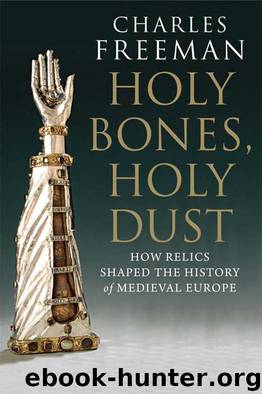
Author:Charles Freeman [Freeman, Charles]
Language: eng
Format: epub, azw3
ISBN: 9780300125719
Publisher: Yale University Press
Published: 2011-05-24T04:00:00+00:00
CHAPTER EIGHTEEN
The Virgin Mary and the Penitent Whore
I
N THE summer of 1113 a small group of clerics arrived at the little port of Wissant near the town of Calais.1 Their leader, Boso, was accompanied by his nephew Robert, two canons from the cathedral of Laon in Picardy, and a number of other clergy. With them they had a precious feretory, a portable shrine, that carried the inscription: ‘May I be consecrated by the sponge, the Cross of the Lord, with the cloth of thy face, also by the hairs of your Virgin Mother.’ Inside, it was said, was part of the robe of the Virgin, the sponge lifted to Jesus's mouth while he was on the Cross, and part of the Cross itself. Some doubted whether there were hairs inside but it was said that a crusader, Ilger Bigod, had found a lock of hair in the Holy Sepulchre in Jerusalem where the lock had been placed after Mary had torn it out during her suffering at the foot of the Cross. Bigod had brought the lock back to France and it had been distributed to different shrines. Laon claimed to be one of them. In the travels that followed, it was the relics of the Virgin that appeared to have most impact, especially as the cathedral at Laon was dedicated to her.
This prominence given to Mary was a major development of the eleventh and twelfth centuries and it was to prosper in new forms throughout the Middle Ages and beyond.2 In earlier centuries Mary had been seen as the stoical mother enduring the horrors of the Crucifixion. Now, just at the time when Christ's sufferings were being highlighted, Mary becomes the one who shares in his distress. She has borne many sorrows and so can understand those of others. ‘The wounds of the dying Christ were the wounds of the mother; the pains of Christ were cruel torturers of the soul of the mother’, as Ogier, abbot of the monastery of Locedio in Piedmont, put it in the early thirteenth century. There is a moving text from the Greek church that beautifully draws together her twin roles. Mary addresses Christ: ‘Then I touched with my lips your lips as sweet as honey and as fresh as dew. Then you slept on my breast as a child, and now you sleep as a dead man in my arms….Once I took care of your swaddling clothes and now of your shroud….Once I lifted you up in my arms when you skipped and jumped like a child, and now you lie [motionless] in them like the dead.‘3 One of the most famous medieval hymns is the Stabat Mater, the mother standing close to Jesus as he dies on the Cross: ‘through her heart, his sorrow sharing, all the bitter anguish bearing’.
Mary was the repository of the world's faith in the days between the Crucifixion and Resurrection and then, in other accounts, takes on responsibility for caring for the Apostles and nurturing the early Church after the Ascension.
Download
Holy Bones, Holy Dust: How Relics Shaped the History of Medieval Europe by Charles Freeman.azw3
This site does not store any files on its server. We only index and link to content provided by other sites. Please contact the content providers to delete copyright contents if any and email us, we'll remove relevant links or contents immediately.
| Africa | Americas |
| Arctic & Antarctica | Asia |
| Australia & Oceania | Europe |
| Middle East | Russia |
| United States | World |
| Ancient Civilizations | Military |
| Historical Study & Educational Resources |
Room 212 by Kate Stewart(5119)
The Crown by Robert Lacey(4814)
Endurance: Shackleton's Incredible Voyage by Alfred Lansing(4780)
The Iron Duke by The Iron Duke(4354)
The Rape of Nanking by Iris Chang(4211)
Joan of Arc by Mary Gordon(4109)
Killing England by Bill O'Reilly(4001)
Say Nothing by Patrick Radden Keefe(3984)
I'll Give You the Sun by Jandy Nelson(3447)
Shadow of Night by Deborah Harkness(3367)
Hitler's Monsters by Eric Kurlander(3342)
Mary, Queen of Scots, and the Murder of Lord Darnley by Alison Weir(3210)
Blood and Sand by Alex Von Tunzelmann(3203)
Eleanor & Park by Rainbow Rowell(3172)
Darkest Hour by Anthony McCarten(3129)
Margaret Thatcher: The Autobiography by Thatcher Margaret(3082)
Book of Life by Deborah Harkness(2938)
Red Famine: Stalin's War on Ukraine by Anne Applebaum(2933)
The One Memory of Flora Banks by Emily Barr(2863)
